Every legal and contract management team enters a new year with a mix of assumptions and blind spots. What helps is understanding how others are setting their priorities: where they're investing, what's expected of them, and what challenges they're up against. This report provides that context to give you a clearer starting point for managing contracts in 2026.
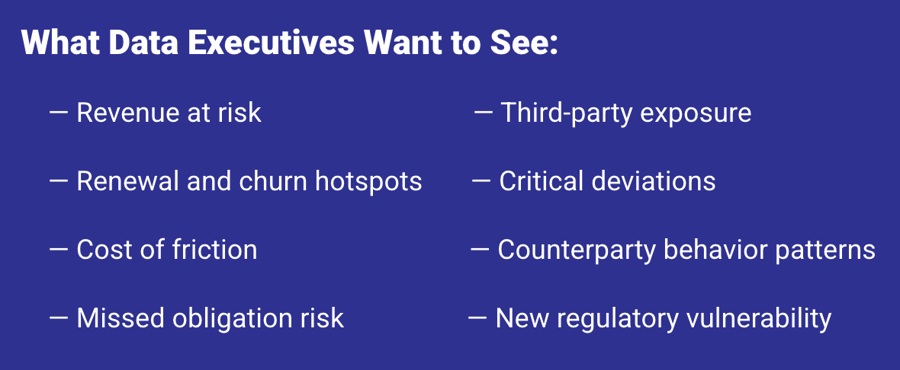
The findings show an industry at a critical inflection point. Turnaround times continue to shorten, AI is beginning to influence drafting and negotiation, and leaders are pushing for more contract insights that support forecasting, revenue accuracy, and risk decisions.
Key findings
In this report, we'll discuss what's influencing these numbers, and what that means for contract management next year.
"Legal has become the first line of defense. Industries keep getting more restrictive, regulations keep coming down, and we're the ones making sure everything gets done correctly. We help each department check their boxes, providing the support and guidance they need."
— Kimberley B., professional sports industry
Section 2
Methodology
Between August and October 2025, we surveyed 50+ general counsel, legal operations leaders, and senior contract professionals to capture unfiltered perspectives on their biggest challenges and strategic priorities for 2026.
The survey respondents represent a broad range of contracting operations, from small legal teams overseeing high volumes to enterprise functions supporting global portfolios. Together, they provide a dataset that mirrors the complexity of modern contracting.
The sections ahead draw on that full dataset, combining quantitative results with qualitative insights from respondents' written feedback and in-depth interviews.
Participant overview
50+ legal and contract management leaders interviewed across diverse industries and geographies
Organizations ranging from 50 to 10,000+ employees, with over two-thirds from companies with 500+ employees
Diverse role representation spanning general counsel, contracts managers, corporate lawyers, paralegals, and legal operations leaders
Section 3 · Priorities & challenges
The Speed Paradox
With the majority citing faster contract cycles as their first priority and shorter turnaround times as their top challenge (70.7%), teams are working in a world where not only the amount of work is increasing and the time to do it decreasing, but the work itself is getting harder.
"There's always something at stake. With our contracts, there could be orders or business relationships pending. Each contract is part of a bigger chain, and the rest of that chain can't move until we do. Everything is tied to something immediate and everybody wants it now."
— Michelle R., industrial manufacturing and engineering industry
Under that pace, it becomes harder to stay on top of obligations and emerging risks across a growing portfolio of agreements. So, it's unsurprising that speeding up contract cycles (81%), gaining visibility (46.6%), and reducing legal risk (43.1%) are among the top priorities — teams need systems that help them work quickly without compromising the accuracy their contracts require.
Section 3 · Priorities & challenges
Complexity Continues
Contract work itself is also becoming more complicated. Survey respondents point to executive demand for data and metrics (44.8%), rising stakeholder expectations (44.8%), and more complex deal structures (43.1%) among the top challenges shaping their workload in 2026.
As contracts move through more jurisdictions, rely on more systems, and involve more early input from the business, the path from request to signature becomes far less linear. More variables mean details shift more easily and the business loses clarity on what it's agreeing to. As these variables expand, organizations will need stronger visibility, analytics, and governance to keep contracting aligned with how the business now operates.
Section 3 · Priorities & challenges
Who's Driving Contract Transformation?
Executive leadership is driving contracting transformation in 65.5% of organizations — far more than any other group. Finance follows at 34.5%, sales and revenue teams at 32.8%, and only 3.4% say their legal or contract team is driving the change.
What stands out is how contracting has moved from document execution to enterprise intelligence. Leaders want the data inside agreements to inform forecasts, financial accuracy, and planning, and that appetite is driving a huge push for modernization.
"When you have a tool that can analyze contracts at scale, the expectations for the legal department are raised. You need to know which contracts are expiring, which will auto-renew, which have built-in rate increases. You have to be more knowledgeable — it can't just be 'let me get back to you.'"
— Ryan E., medical services industry
Section 3 · Priorities & challenges
What Success Looks Like
The KPIs teams plan to track in 2026 show a shift toward deeper visibility into the health of their contracts and the processes behind them. Contract cycle time remains the top metric at 70.7%, but organizations are also prioritizing contract analytics (62.1%) and template standardization adherence (53.4%). Rather than viewing productivity as the sole indicator of success, teams are emphasizing visibility, consistency, and quality — the foundations that make speed achievable and sustainable.
"KPIs are crucial for spotting slowdowns or gaps in the process. But at the end of the day, the biggest measure of success is the strength and quality of the contract, not just how quickly it was finalized."
— Maggie M., healthcare and insurance industry
Historically, legal departments didn't have the tooling or data structure to measure much beyond volume or turnaround time. The KPIs gaining traction now demand more mature processes and reliable data — signs that contracting is moving toward operational rigor rather than reactive, task-by-task effort.
In a contracting environment defined by rising variability, these KPIs function as guardrails. They help teams identify where work is veering off-track and where risk is accumulating long before it becomes a problem. Ultimately, they give teams a firmer basis for making decisions about where to focus their time — and where not to.
Section 4 · Negotiation & collaboration
Negotiation Bottlenecks
Nearly a third of respondents say negotiation creates the most friction, and the common denominator is control. Drafting, review, and execution run within predictable guardrails. Negotiation doesn't, and once multiple parties or external dependencies enter the picture, workflows get harder to manage.
"By the time a deal reaches negotiation, a lot of eyes are on it. Everyone has a stake: the customer needs the software, sales wants the commission, the business wants the contract closed. That pressure and anticipation create friction all on their own."
— Lee R., software and technology industry
Interestingly, respondents' top two risk-reduction strategies — stronger templates and clearer fallback language — may seem unrelated to negotiation, but they point to a push to settle as many decisions as possible before a contract ever hits the negotiation table. Both strategies are ways to avoid mid-negotiation surprises and bring more predictability to the process.
Section 4 · Negotiation & collaboration
Collaboration Growth
Collaboration is shifting toward the teams that own the organization's biggest risks, like IT and InfoSec (51.7%), procurement (34.5%), finance (32.8%), and compliance and risk (31%). Their increased involvement reflects how much higher the stakes have become around data, security, and spend — and how little room there is for getting those decisions wrong.
For contract and legal teams, the real work is reconciling these competing demands into a contract that holds up under scrutiny and still gets signed on time:
"Negotiation has been the biggest challenge. The 'awaiting approval' and 'in negotiation' steps happen at the same time — every reviewer requests changes, those edits go back to the business, and then we go back and forth with the counterparty. We rely on the departments requesting the contract because they're the experts on what's needed, but that also adds more cycles."
— Erin L., higher education industry
Section 5 · Risk & visibility
The Visibility Gap
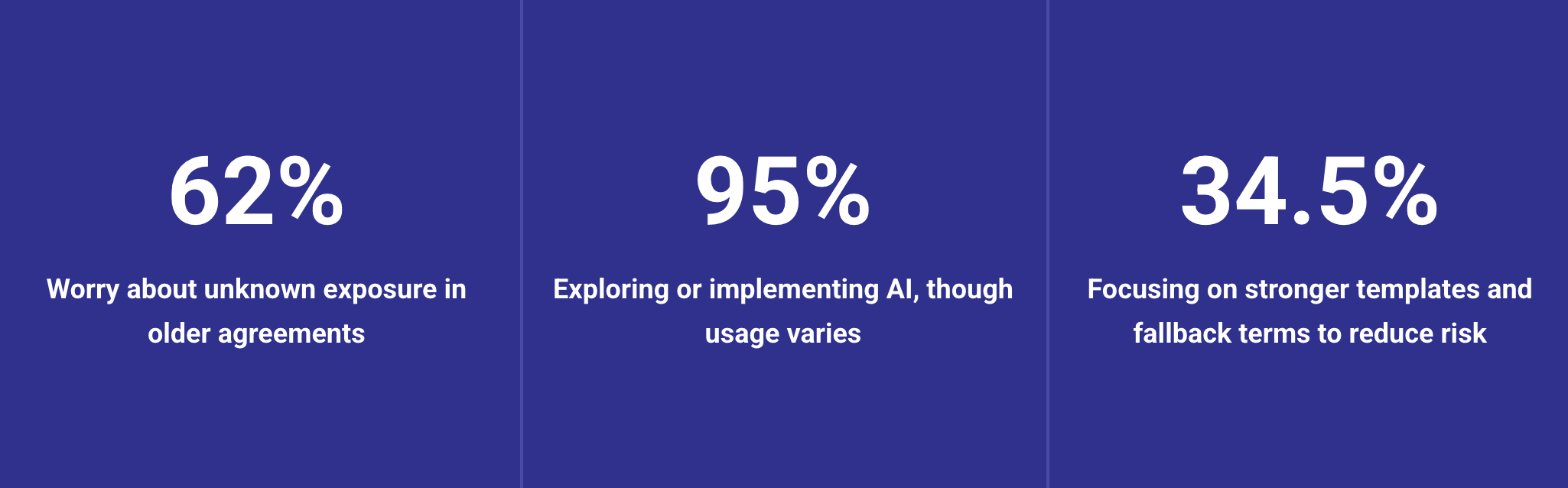
The riskiest parts of many portfolios are the agreements that have been in place the longest: 62% of teams cite unknown exposure in older contracts, and 57% say missed obligations are among the top risks heading into 2026.
Many legacy contracts fall short of the clarity regulators, auditors, and internal stakeholders now expect. The business is being asked to defend commitments created in a different contracting environment, and teams are discovering how little of that history is documented in a way they can rely on. Even when the documents are accessible, it's difficult to confirm what's current, what has been amended, and where risk may still sit.
"As contracts get longer and more complex, it becomes harder to be confident you've caught everything. A ten-page agreement feels manageable; a two-hundred-page one is where you start to wonder what you might have missed."
— Meredith W., engineering industry
For many, that uncertainty deepens over time:
"There's always a fear of the unknown in contracts you didn't negotiate yourself. The longer something stays buried, the closer you get to a problem you didn't see coming — and the less time you have to prevent or mitigate the risk."
— Ryan E., medical services industry
Section 5 · Risk & visibility
Contract Areas Under Scrutiny
The four contract risk areas drawing the most scrutiny heading into 2026 — obligations (90%), data protection (79%), AI terms (43%), and audit requirements (43%) — all face the same challenge: constant change.
New regulations, evolving data privacy frameworks, and the pace of change in AI keep redefining what "compliant" looks like. Teams adjust language, but when the goal posts keep shifting, keeping contracts aligned remains one of the hardest parts of the job.
"With the changing economy and everything the government is doing — especially around labor staffing and contract compliance — every new state regulation forces us to rethink how our contracts hold up in that particular hotel or municipality. The target keeps moving."
— Eric H., hospitality industry
That lag hits vendor agreements hardest. Seventy-one percent of respondents expect these type of contracts to feel the most pressure from external change, followed closely by privacy and security assessments. Since these documents hinge on ever-evolving data and security requirements, it's unsurprising that they're often the agreements that teams must recalibrate first.
Section 5 · Risk & visibility
Third-Party Complexity
Everywhere third parties show up, the work gets harder. Most respondents say they encounter contract challenges with vendors or partners at least occasionally (68.9%), with 15.5% saying they see them often.
"Anytime a contract depends on a third party — data, services, integrations — it takes longer and the risk goes up, because we don't control those pieces."
— Erin L., higher education industry
For many teams, the sticking points they see trace back to how much of today's contracting relies on third parties. Vendors, for example, handle key pieces of the workflow, from how data is processed to how systems integrate, yet internal teams inherit the outcomes.
As organizations head into 2026, those external dependencies will play a bigger role in how confidently teams can meet their own standards, respond to audits, and keep up with change.
Section 6 · AI in contracting
AI Adoption Accelerates
Across nearly everyone surveyed, AI is moving from experiment to expectation. Ninety-five percent of teams are either exploring or actively implementing it, and the range of adoption stages — exploratory (34.5%), gaining traction (32.8%), and accelerating rapidly (27.6%) — reflects an industry finding its footing.
So far, teams are using AI for the high-volume, low-risk tasks that have historically drained hours from legal, including drafting, summarizing, clause detection, and search. Search and reporting are the most common uses (29.3%), followed closely by AI-assisted authoring (25.9%). Set against the broader expectations for AI, it's a reminder that adoption remains uneven across the lifecycle — strongest in the stages where teams feel a little more confident about what AI should do, and far lighter where operationalizing it is still unclear.
"AI is ultimately about increasing productivity without adding headcount. By 2026, I expect it to handle the first layer of work on almost every contract we touch — whether we drafted it or it came from a counterparty — which lets us shift people toward higher-level work."
— Steve B., retail industry
Section 6 · AI in contracting
Agentic AI: Expectations vs. Reality
Agentic AI has gained a foothold in many organizations and a significant share are exploring or scaling AI more broadly. But looking at where it's used, only around 20% apply it to negotiation-specific tasks. That disconnect raises a central question: if AI is accelerating work, why isn't it being used where friction in the contract lifecycle is highest?
Comments point to a mix of awareness and readiness issues: Do we trust our templates and playbooks enough to let an agent act on them? How often should we revisit our policies to make sure the agent acts according to our current contract process? Who confirms that an agent's output aligns with the intended goals?
Until the policies and the division of responsibility across legal, IT, risk, and operations feels clearer, teams will keep using agentic AI in narrow, well-controlled ways, even when the technology could reasonably support more.
"AI governance is like the house and the AI policy is the furniture. People rush to create policies, but without governance guardrails — without understanding what's unique to your organization first — those policies have no foundation."
— Bahara S., higher education industry
Section 6 · AI in contracting
Defining AI Success
If operational readiness explains where AI isn't yet applied, the lack of benchmarks and a shared definition of success explains why teams struggle to measure the impact of the AI they already use.
"We're seeing a lot of potential use cases, but we're still figuring out which ones are the best and how to measure whether they work. Right now, the clearest sign of success is adoption itself — getting people comfortable enough to use the tools and learn what's possible."
— Steve B., retail industry
Respondents overwhelmingly expect AI to make drafting and redlining faster (81%), strengthen risk detection (65.5%), and automate more of the workflow (50%). But even in these high-confidence areas, many say they still haven't agreed on the indicators that show AI is actually improving the work. Without shared benchmarks, it's difficult to compare value across teams or pinpoint which use cases deserve more investment.
Section 7 · Preparing for 2026
Preparing for 2026
Teams preparing for 2026 are focusing less on adding new tools and more on reinforcing the structures that make their work predictable. Standardization — of templates, fallback terms, approval paths, and negotiation guardrails — has emerged as the single strongest lever for reducing contractual risk.
In the survey, the top two opportunities to mitigate exposure were standardizing templates or fallback terms (34.5%) and standardizing approval workflows (25.9%). The results suggest that as more factors around the contract keep changing, teams increasingly need the process itself to be the constant.
"Our big push isn't just technology or adoption or getting faster. We have to figure out how we need to adjust our processes and rules to account for new technologies. It requires a lot of flexibility as we think about being lawyers not only in 2026, but also in 2030."
— Steve B., retail industry
For many organizations, standardization is becoming the connective tissue that holds modern contracting together. It's what enables faster internal reviews, clearer negotiation boundaries, and a more consistent experience for business users. It's also what creates the conditions for AI to be effective — the more uniform the structure of the work, the easier it becomes to automate the first pass of a document, compare clauses, or align changes with internal policy.
Section 7 · Preparing for 2026
Integration on the Rise
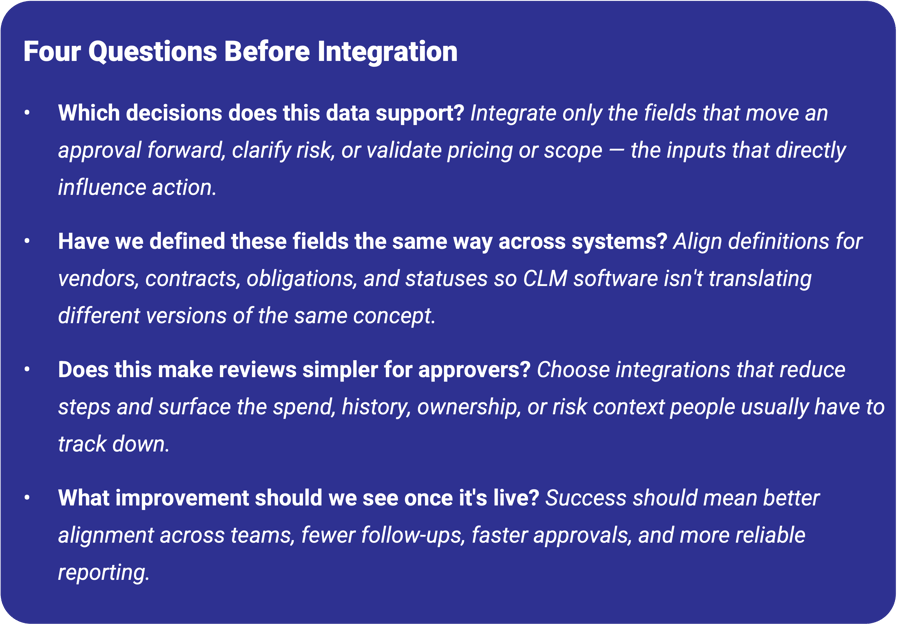
Every team approaches contracts with different assumptions about what matters. From various risk appetites to mismatched terminology, reviewers often need to align on interpretation to make sense of a contract.
This year's responses show more teams treating integration as a way to bring consistency to reviews that involve multiple stakeholders and systems. As workloads grow and expectations tighten, they're prioritizing anything that reduces rework and reconciling data from numerous tools.
"Approvers all care about different things — finance wants one set of metrics, legal wants another. The real work is figuring out how to pull those details together and surface them in the software so people can actually see what matters and report it up the chain."
— Lee R., software and technology industry
Section 7 · Preparing for 2026
AI Proficiency as a Core Skill
Nearly every respondent pointed to AI proficiency as a must-have skill for 2026. Teams understand that knowing how to direct, question, and validate AI output is quickly becoming part of the job.
"Having a growth mindset is everything. You have to embrace AI. AI isn't going to replace your job — but someone who knows how to use AI in their workflow will. That's the real competition."
— Bahara S., higher education industry
But technical fluency only goes so far. The harder skill is judgment — the human-in-the-loop that decides whether an AI-generated clause meets the spirit of a negotiation, whether a risk is truly acceptable, or when a contract needs escalation. The more automation enters the workflow, the more valuable that discernment becomes.
"Critical thinking is still the most important skill. Just because something fit a cookie-cutter approach once doesn't mean it works the next time. You have to build relationships, loyalty, and trust on all sides — and remember that a contract is supposed to be mutually agreeable."
— Michelle R., industrial manufacturing and engineering industry
FAQ
Questions About 2026 Trends
What are the biggest contract management priorities heading into 2026?
The top priorities center on speeding up contract review and approvals, improving internal collaboration, gaining visibility into contract data and terms, and reducing legal risk.
Why are negotiation stages creating so much friction for teams?
Negotiation introduces variables teams can't fully control. Once multiple reviewers, external dependencies, and counterparty demands enter the process, alignment takes longer and cycles multiply.
Why are legacy contracts such a major risk going into 2026?
Older agreements often carry unknown exposure because teams didn't negotiate them, don't have clean amendment history, or can't quickly confirm what is current. That uncertainty makes missed obligations and hidden risk harder to prevent.
What contract areas are getting the most compliance scrutiny?
Teams are seeing the most scrutiny around contractual obligations, data protection, AI-related terms, and internal audit requirements — areas that keep shifting as regulations and standards evolve.
Where is AI actually being used in contract management today?
Most teams are applying AI to high-volume, lower-risk work such as searching, reporting, authoring support, summarizing, and clause detection. Usage remains lighter in negotiation and post-signature stages.
What does "agentic AI" mean in a contract management context?
Agentic AI refers to AI that can take action across steps in the workflow — using your guardrails and policies — rather than only generating text or answering questions. Many teams are still limiting it to narrow use cases until governance and accountability are clearer.
What does success with AI look like in 2026?
Teams expect AI to drive productivity most in drafting/redlining, risk detection, and workflow automation. Many are still working toward shared benchmarks that prove AI is improving outcomes beyond adoption alone.
Conclusion
Wrapping Up
Across industries, teams are looking for the same thing: more predictability in the less predictable aspects of contract management.
Right now, process consistency is still hard to achieve. Inherited legacy agreements, external dependencies during approvals, and evolving regulations continue to bottleneck teams and pull them back into work they thought was already completed. But the findings throughout this report show where stability is most accessible, and how targeted improvements can create outsized impact.
Focus areas for 2026
Improve visibility into legacy and high-risk agreements
Streamline routine reviews and approvals
Standardize negotiation starting points and playbooks
Build AI capability on a foundation of skills and standards
The more teams reinforce the pieces they can control — the language, the templates, the underlying approval processes — the easier it is to see where the true roadblocks are, and to overcome them faster.
Take the 2026 report with you
Download the full CLM Trends Report as a PDF, or see how IntelAgree helps legal and contract teams act on these priorities.