




What Makes Contract Negotiation So Hard to Control?
Why does contract negotiation create more friction than any other stage of the contract lifecycle? Because it’s the only stage where internal alignment and external opposition happen simultaneously, under commercial pressure from sales. The 2026 CLM Trends Report found 32.8% of legal and contract leaders identified negotiation as the highest-friction stage — a direct consequence of more departments now weighing in on every deal.
Negotiation often breaks down in ways that have nothing to do with the quality of your team or the care that goes into drafting. According to the 2026 CLM Trends Report, 32.8% of legal and contract leaders named it their highest-friction stage. The stage itself is designed to be unpredictable, and most teams are managing it with systems that weren’t built for that.
Why Does Negotiation Create More Friction Than Any Other Lifecycle Stage?
Most stages of the contract lifecycle operate inside boundaries you can control.
In drafting, you control the document. You’re working from a template with a defined set of internal reviewers, and nothing leaves the building until it’s ready. In execution, you control the sequence. Signatures follow a known order, the terms are already agreed to, and the path to completion is clear and linear.
That control disintegrates as soon as a draft enters negotiation. Once a contract goes to a counterparty, both the document and the timeline are no longer yours to manage. Their legal team can introduce redlines at any point, on any clause, and each change sends the document back to square one.
That endless loop of reviewing and redlining is what makes negotiation structurally unpredictable compared to every other stage. The process itself introduces instability, and most organizations don’t have a system designed to sustain it.
As IntelAgree’s own general counsel, Lee Rone, stated in the report:
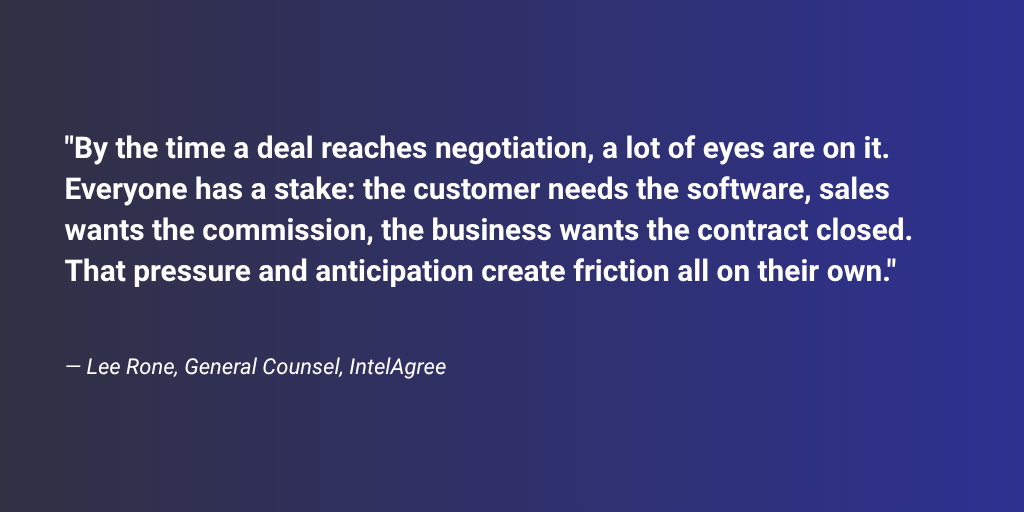
Sales is focused on closing, finance is focused on exposure, and legal is focused on the long-term risk in the language. Each priority is valid, but they pull in different directions, and negotiation forces those tradeoffs into the open.
Here’s what that dynamic often looks like:
- Conflicting stakeholder edits: Finance redlines a payment term, sales pushes it back, and legal has to resolve it.
- No clear decision owner: Authority isn’t defined upfront, so every escalation becomes a new conversation.
- Redlines reopening settled issues: A counterparty change triggers internal debate on points that were already resolved.
- Legal as the default gatekeeper: Legal touches every version, so every question routes back to them, whether it belongs there or not.
- Counterparty delays stalling internal cycles: Every counterparty delay reopens internal debate on positions you had already settled.
So, how does this hurt your business?
- Slower revenue recognition
- Deals that stall during long cycles
- Unsustainable legal workloads that lead to burnout from repeated escalations
- Inconsistent contract terms across the portfolio
Why Are So Many Departments Now Involved in Contract Negotiation?
A decade ago, a standard commercial agreement might have been reviewed by legal and a single business owner before reaching signature.
Today, legal reviews core terms and liability, IT and InfoSec handle data processing and security requirements, procurement validates the vendor relationship and spend, finance reviews payment terms, renewals, and exposure, compliance checks regulatory alignment, and sales tracks the timeline and pushes anything that threatens the close.
That’s six functions reviewing the same document, all with a legitimate stake, but limited visibility into what others have already requested. The 2026 report reflects how widespread their involvement is now:
- IT and InfoSec: 51.7%
- Procurement: 34.5%
- Finance: 32.8%
- Compliance and Risk: 31%
- Sales: 25.9%
When each department reviews independently and returns edits, those edits have to be reconciled against every other reviewer’s feedback before anything goes back to the counterparty. The counterparty responds with its own revisions, and the cycle starts again.
The more people who have to sign off, the less controllable negotiation becomes. Gartner’s 2025 buyer research found 74% of B2B buying teams demonstrate “unhealthy conflict” during the decision process, with groups running as large as 16 people across four functions.
In short, you end up as the mediator between internal departments while managing an external negotiation at the same time. While the role has always required navigating competing priorities, the structural complexity has grown alongside the number of stakeholders now involved in every deal.
The collaboration data and the negotiation friction data in the 2026 report describe the same shift from two angles. As more departments get involved in review, feedback cycles start to overlap, version conflicts increase, and redline rounds with the counterparty multiply. The 32.8% who identified negotiation as the highest-friction stage are seeing the outcome of that shift play out in real time.
What Does the Rise of IT and InfoSec Mean for Contract Workflows?
InfoSec is one of the few reviewers whose “no” isn’t negotiable. Vendor agreements, software deals, and partnerships now include data processing addenda, security questionnaires, GDPR and CCPA provisions, vendor risk clauses, and AI-use policies. These terms often determine whether a deal moves forward, and they require specialist review you can’t handle alone.
InfoSec’s involvement stands apart because the provisions they review are highly specific, covering data classification, penetration testing, breach notification timelines, and sub-processor restrictions. You often can’t assess whether a clause aligns with the organization’s actual security posture without input from someone who understands the underlying systems. That dependency introduces a hand-off that slows the process in ways other reviews don’t.
Beyond that, InfoSec’s positions are often driven by regulatory requirements or internal security policy. When a counterparty pushes back on a data provision, the answer is usually a hard no, because the requirement behind it isn’t a preference. That dynamic slows response times and can stall deals that are otherwise close to the finish line.
InfoSec teams also manage risk across every vendor relationship at once, so their review queue is often backed up. While the counterparty waits on you and you wait on InfoSec, the timelines drift with no mechanism to realign.
As Erin L. from the higher education industry described it in our 2026 trends report:
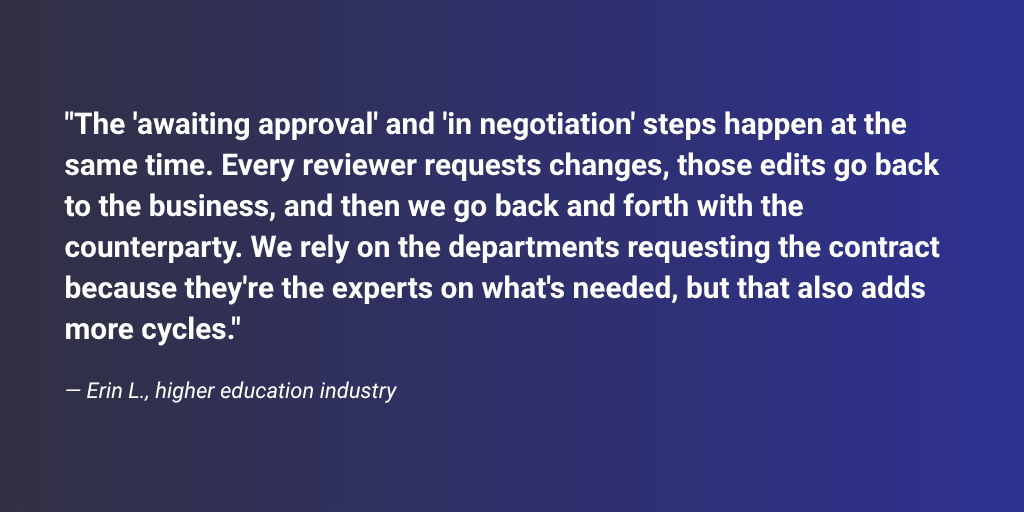
The breakdown is that most contract workflows assume approvals and negotiations happen in sequence, when in reality they unfold at the same time. There’s no system for reconciling overlapping inputs. When InfoSec returns a redline just as the counterparty sends its version, you’re left juggling conflicting changes with no clear way to merge them.
Most traditional contract management workflows also weren’t designed to handle concurrent internal review alongside external negotiation. Clause-level routing is often missing, so every reviewer sees the entire document. Version control rarely separates internal drafts from counterparty edits, which makes it difficult to track where changes originated. When required language is removed, there are often no alerts, and the gap between what legal approved and what actually gets signed only becomes apparent after the fact.
Why Do the Best Risk-Reduction Strategies Happen Before Negotiation Starts?
The top two strategies legal teams are using to reduce negotiation risk both sit outside the negotiation itself: stronger templates and fallback terms (34.5%) and standardized approval workflows (25.9%).
Both strategies work on the same principle: the hardest debates should occur when your team has dedicated time to think them through. Pre-negotiation prep is really about closing the gap between what your organization actually believes and what it can articulate under pressure.
Stronger Templates and Fallback Language
Pre-approved fallback language means you don’t have to wait for internal sign-off on positions that repeat across deals. When your organization’s position on indemnification, data processing, or liability caps is already argued through, approved, and documented, a counterparty redline triggers a prepared response. Your position is settled before the redlining begins, so the counterparty is negotiating against a policy.
Standardized Approval Workflows
Standardized approval workflows solve the coordination problem at its source. Instead of sending every version of a contract to every reviewer, authority approvals route specific clauses to the right stakeholders based on predefined thresholds.
In the 2026 report, 53.4% of respondents identified template standardization adherence as a top KPI. In other words, standardization has moved from a control legal owns to a KPI the business tracks.
Teams that have already built this kind of structure are seeing measurable results. Emergent Health Partners standardized templates through IntelAgree and cut standard contract generation to five minutes. Bolton & Menk standardized templates and approval processes through IntelAgree, eliminating the rework that comes from every deal starting from a different internal baseline.
What Good Negotiation Operations Look Like
A well-run negotiation workflow is recognizable by what you’re not doing in it. You’re not chasing approvers, relitigating fallbacks, or reconstructing what happened to a clause after it was signed. The decisions behind that were made before the contract left your hands:
- Pre-defined risk thresholds. Risk scoring frameworks, where you choose the contract attributes that are most important to you, set scoring bands, and assign weights, give legal and business stakeholders a shared vocabulary for prioritization. True contract risk scoring supports that approach by letting you build a framework that reflects your organization’s actual risk tolerance rather than a generic default.
- Clause-level routing over full-document reviews. Instead of sending the entire agreement to every stakeholder, structured workflows route specific sections to the right reviewers, like sending payment terms to finance. Each reviewer sees what’s relevant to them, which leads to faster reviews, less noise, and fewer comments on sections outside their scope.
- Redline guardrails that catch slip-ups. One of the most common post-negotiation surprises is discovering that required compliance language was removed and never reviewed before execution. The 2026 report found that 91.4% of respondents say contractual obligations receive the most compliance scrutiny of any contract element, which means the gap between what was agreed during negotiation and what gets signed remains a real exposure. IntelAgree’s redlining capability, for example, flags when required compliance language gets removed and routes those exceptions for review before signature.
- Obligation tracking tied to automation. In the 2026 report, 56.9% of respondents cited missed obligations as a top risk for the year ahead. But automated alerts for renewal windows, certification expirations, and compliance deadlines ensure obligations surface on time with enough lead time to act.
- Clear decision authority. Someone needs to own the final call on contested clauses, and that ownership should be defined before negotiation begins. Without it, decisions stall mid-cycle while the counterparty waits and internal stakeholders debate positions in real time.
Long contract cycle times are often the result of fragmented workflows, inconsistent approvals, and siloed contract processes rather than the people managing the work. That’s why anything you settle before the counterparty gets involved is one less thing that could potentially stall your deal.
How Should Contract Management Software for Legal Departments Address Negotiation?
Most CLM software vendors will show you drafting speed and eSignature capabilities. Those are table stakes.
The harder question is how the platform handles coordination:
- Does it route approvals by clause type or only by contract value?
- Does it flag when required language gets removed, or only track that a change occurred?
- Does it support concurrent internal review and external negotiation without creating version chaos?
- Can you configure risk scoring to reflect your organization’s actual thresholds, or are you working from a preset formula?
The difference between a platform that helps and one that just digitizes the existing chaos comes down to whether it was designed for how negotiation actually works.
For a deeper look at these trends, explore the full 2026 CLM Trends Report here.
Frequently Asked Questions
Question: Why is contract negotiation harder to control than drafting or execution?
Drafting is internal and template-driven, and execution follows a defined sequence. Negotiation introduces a counterparty with its own timeline and priorities while internal stakeholders are reviewing and editing at the same time. A single redline can restart internal alignment, making the process less predictable. That combination of external input and overlapping internal decisions creates the highest friction.
Question: Why are IT and InfoSec more involved in contract review today?
Contracts now include data processing terms, security requirements, and regulatory obligations that require technical review. Legal often relies on InfoSec to assess whether those clauses align with the organization’s actual systems and risk posture. Many of these requirements are driven by regulation, which limits flexibility in negotiation. As a result, IT and InfoSec are involved in more than half of contracts according to the 2026 CLM Trends Report.
Question: How do standardized templates reduce contract negotiation delays?
Many delays come from waiting on internal approval for common clause positions. Standardized templates with pre-approved fallback language remove that delay for repeat decisions. When a counterparty pushes back, legal can respond immediately instead of escalating internally. This keeps negotiations moving and reduces unnecessary cycles.
Question: What does a good contract negotiation workflow look like?
A well-designed workflow routes specific clauses to the right reviewers instead of sending full contracts to everyone. It defines decision authority upfront and maintains pre-approved positions for high-friction clauses. It also includes guardrails that flag risky changes before execution. These elements reduce coordination overhead and keep negotiations moving.
Question: How many people are typically involved in contract negotiation today?
Contract review now extends well beyond legal and a single business owner to include IT, InfoSec, procurement, finance, compliance, and sales. Each additional stakeholder adds input that must be reconciled before changes go back to the counterparty, increasing cycle time in a compounding way. Structured workflows help manage that involvement without overloading legal.
Additional Reading
 How AI Contract Management Software Adapts to Your Negotiation Style — A closer look at how AI-powered CLM tools can flex to match how your team actually negotiates, rather than forcing you into a rigid process.
 Contract Risk Management: How to Identify and Prevent Exposure at Scale — A look at where contract risk actually accumulates, why manual review breaks down at scale, and how legal teams can build more consistent, measurable risk management processes across the contract lifecycle.
 The Speed Paradox: Why Contracting Gets Harder As It Gets Faster — A look at why faster contract cycles have made the surrounding work harder, and what legal teams need to keep speed and control from pulling in opposite directions.