




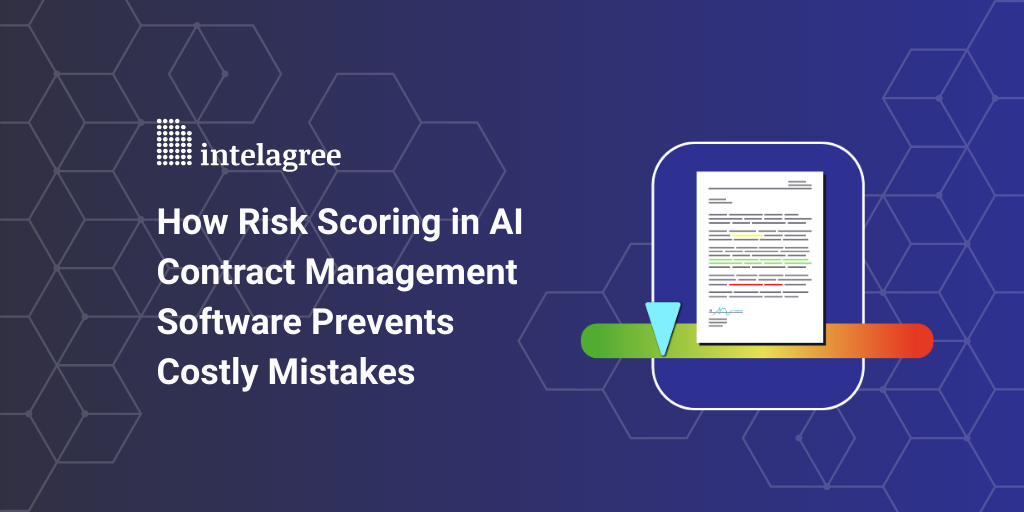
How Does Risk Scoring in AI Contract Management Software Work?
Risk scoring in AI contract management software uses artificial intelligence to automatically analyze contract attributes, assign quantifiable risk values, and create measurable risk profiles across an entire contract portfolio. By converting subjective risk assessments into objective data points, AI-powered risk scoring helps legal teams identify high-risk agreements before they create financial or compliance exposure.
Risk exists in all your contracts, but if you can't measure it consistently, you can't manage it strategically.
Most organizations assess contract risk the way they always have: by relying on institutional knowledge, gut instinct, and whoever happens to remember that one problematic deal from two years ago.
This approach works until a missed renewal costs six figures, or a compliance audit reveals obligations no one knew existed, or conflicting risk assessments between departments stall a critical deal for weeks.
AI contract management software, however, provides a systematic approach that turns vague risk assessments into precise, actionable intelligence: risk scoring. Instead of asking "Does this contract feel risky?" with risk scoring, you can see exactly where risk exists, how much, and why.
Why is Traditional Contract Risk Assessment Unscalable?
Walk into any legal department and ask three different people to assess the same contract's risk level. You'll likely get three different answers. Risk shows up in different places depending on who’s reviewing the agreement, and those reviews rarely happen with the full context in view.
That disconnect affects how contracts move through approvals. Agreements that deserve careful scrutiny often slip through with standard sign-off because no single reviewer sees the cumulative risk. Meanwhile, routine contracts get escalated unnecessarily because someone spots a single clause that triggers their personal risk radar. The result is a backwards approval process where high-stakes contracts move too fast and low-stakes contracts move too slowly.
The underlying issue with this is scale. When you're managing hundreds or thousands of agreements, manual risk assessment becomes impossible to apply consistently. Your most experienced contract manager might catch problematic auto-renewal language in vendor agreements on Monday, but miss similar language in customer agreements on Friday when they're rushing to clear their queue. Meanwhile, newer team members lack the pattern recognition to spot risks that veterans consider obvious.
Traditional contract management systems don't solve this problem because they weren't designed to. They might flag specific dates or send renewal reminders, but they can't tell you whether Contract A poses more business risk than Contract B. They store contracts; they don't interpret them.
What Makes AI-Powered Contract Risk Scoring Different?
AI contract management software approaches risk assessment the way a veteran contract manager would, if that person could instantly review every agreement in your portfolio and remember every problematic pattern they'd ever encountered.
In IntelAgree’s case, that starts with attributes teams already associate with risk. Rather than treating contracts as undifferentiated documents, the platform lets organizations define which elements matter — things like payment terms, renewal structure, governing law, or liability limits — and then surface those attributes consistently across agreements, even when the language varies from contract to contract.
Those attributes become the basis for scoring. Teams decide what falls within tolerance and what doesn’t. A 30-day payment term might score as low risk. A 90-day term might score as medium risk. Net 120 could trigger a high-risk classification. Once the relevant attributes are in place, the system applies these scoring rules across your entire contract repository and creates a comparable risk assessment regardless of when contracts were signed or who negotiated them.
IntelAgree, for example, allows teams to configure scoring bands for each attribute, assign different weights based on business priorities, and choose whether to calculate overall risk using weighted averages or cumulative totals. This flexibility means your risk scoring reflects your organization's actual risk tolerance rather than generic industry standards.
As your team reviews contracts and makes decisions, consistent scoring and attribute data make it clear which combinations tend to trigger escalations or amendments. Patterns that are easy to miss in individual reviews become visible across the portfolio—like how contracts from certain regions consistently include problematic liability language, or how deals above certain dollar thresholds tend to have more favorable payment terms.
What Gets Measured Gets Managed
One benefit of risk scoring is that it changes how decisions get made. Consider renewal management: most organizations set calendar reminders for contract expiration dates, which prevents you from accidentally letting agreements lapse. But it doesn’t tell you which renewals deserve proactive attention.
With risk scoring, you can sort upcoming renewals by risk level and commercial value simultaneously. That high-risk, high-value vendor contract renewing in 90 days gets review priority over the low-risk software license renewing next week. Your team stops treating all renewals as equal urgency and starts allocating effort where it matters most. In short, when the criteria are transparent and agreed on upfront, risk scores stop being debated and start being used.
The same logic applies to contract approvals. Setting risk thresholds allows you to automate routing decisions. Contracts scoring below your low-risk threshold can flow through standard approvals without executive review. Agreements hitting medium-risk thresholds might require department head sign-off. Anything triggering high-risk scores automatically escalates to general counsel. The system enforces consistent approval standards without requiring someone to manually categorize every contract.
That prioritization also carries into financial planning. Payment terms, penalties, and timing clauses stop being buried in individual agreements and start influencing forecasts. When you can quickly identify which agreements have 90-day payment terms versus 30-day terms, or which contracts include steep late payment penalties, you can build more accurate cash flow projections.
Moving from Reactive to Strategic
Perhaps the most significant shift risk scoring enables is changing legal's role from reactive contract reviewer to strategic business advisor. When you're stuck manually reviewing contracts one at a time, you're always responding to requests instead of fixing the problems that create them.
With portfolio-level risk visibility, you can identify patterns that suggest policy changes. If 40% of your vendor contracts score as high-risk due to payment terms, maybe the issue isn't individual negotiations — maybe your standard payment terms need revision. If customer agreements consistently score higher risk than vendor agreements, that imbalance might indicate your sales team needs better negotiation training or updated contract templates.
Risk scoring also improves how legal communicates with other departments. Instead of explaining why a contract is problematic using legal terminology that non-lawyers struggle to follow, you can point to a risk score and the specific attributes driving it. The conversation shifts from "Trust me, this is risky" to "This contract scores 8.5 out of 10 because of these four specific provisions, and here's what we need to change to bring it to acceptable risk levels."
Things to Consider When Implementing Contract Risk Scoring
Adopting risk scoring requires more than just enabling a feature in your contract management software. The scoring model needs to reflect your organization's actual risk tolerance, which means having honest conversations about what matters most to your business.
Start by identifying the contract attributes that genuinely drive risk decisions in your organization. Focus on the factors that influence whether agreements get approved, amended, or escalated, which will vary by context. In some organizations, payment terms dominate risk discussions. In others, liability exposure or renewal mechanics carry more weight based on past experience.
Once you've identified key attributes, you need to define what constitutes low, medium, and high risk for each one. This requires cross-functional input. Legal might consider certain liability provisions high-risk, but the business might accept that risk in exchange for faster deal closure. Finance might want strict payment term thresholds, but sales might need flexibility to close competitive deals. Your risk scoring model should represent negotiated organizational consensus, not just legal's preferences.
Some AI contract management software now offers AI-assisted configuration that suggests appropriate scoring bands and weights based on industry best practices. This can accelerate implementation, but you should still review and adjust the AI's recommendations to match your specific situation. A risk scoring model that works for a startup won't necessarily work for an enterprise, and vice versa.
How Risk Scoring Applies After Contracts are Signed
After contracts are executed, they don't stop creating risk. They just shift from negotiation risk to performance risk. Does the other party meet their obligations? Are you meeting yours? Are changing business conditions making previously acceptable terms problematic?
AI contract management software with risk scoring capabilities can re-evaluate executed agreements as conditions change. A contract that originally scored as low risk may warrant review if its terms change through amendment, key dates approach, or updated scoring criteria reflect new areas of exposure. As organizations evolve through expansion, acquisition, or policy shifts, risk scoring makes it possible to reassess existing agreements against current standards.
This kind of dynamic risk assessment is impossible with manual processes. You can't realistically ask someone to periodically review hundreds of executed contracts to see if any deserve renewed attention. But AI contract management software can do this automatically, flagging contracts whose risk scores have increased based on evolving terms or criteria that gets updated.
What Organizations Gain from Contract Risk Scoring
Risk scoring changes what organizations are able to do consistently, not just what they’re able to see.
First, it removes friction from low-risk work without weakening oversight. When risk is explicit and comparable, routine agreements stop competing for attention with genuinely complex ones. Legal time shifts away from clearing obvious approvals and toward the contracts that actually warrant judgment, which shortens cycle times while preserving control.
Second, it builds institutional knowledge that survives personnel changes. Over time, organizations build a record of how they evaluate agreements: what gets escalated, what gets amended, and what moves forward unchanged. When that gets codified into risk scoring rules and attribute weights, new team members inherit a clear sense of tolerance and standards instead of trying to infer them from past deals.
Third, it gives negotiations firmer footing. Patterns across a portfolio are harder to ignore than one-off problems. When you can demonstrate that certain terms consistently produce problematic outcomes across your portfolio, you negotiate from a position of evidence rather than preference.
When risk is measured consistently, small decisions stop creating outsized downstream problems. For more perspectives on how AI-driven intelligence redefines risk, negotiation, and contract management as a whole, subscribe to the IntelAgree blog.
Frequently Asked Questions:
Question: How accurate is AI risk scoring compared to human review?
Answer: AI risk scoring isn't meant to replace human judgment. It's designed to make that judgment more consistent and scalable. The system scores contracts based on the criteria and thresholds your organization defines, so accuracy depends on how well those rules reflect your actual risk tolerance. Most organizations find that AI scoring is more consistent than manual assessment because it applies the same logic every time, while human reviewers can be influenced by workload, time pressure, or recency bias.
Question: How do teams decide which attributes to score first?
Answer: Most teams start with the attributes that already drive friction, escalation, or second-guessing today. The best candidates are the terms that routinely trigger debate in approvals, slow negotiations, or show up in post-mortems after something goes wrong. Payment terms, liability caps, renewal mechanics, and governing law are common starting points because they tend to influence decisions repeatedly across large portions of a contract portfolio. The goal is to capture the handful of factors that account for the majority of risk conversations, then expand as patterns become clearer.
Question: Does risk scoring work for all contract types?
Answer: Risk scoring is most effective for contract types where you have clear, consistent criteria for what constitutes acceptable versus problematic terms. Standardized agreements like vendor contracts, customer agreements, and NDAs are ideal candidates. Highly bespoke contracts might benefit less from automated scoring because each deal is unique enough that automated comparison provides limited value. Most organizations implement risk scoring for their high-volume, repeatable contract types first, then expand to other categories as they refine their approach.
Question: How does risk scoring integrate with contract playbooks?
Answer: Risk scoring and contract playbooks complement each other naturally. Your playbook defines acceptable and unacceptable terms for different contract types — essentially, your negotiation standards. Risk scoring measures how well specific contracts align with those standards. Some AI contract management software can even auto-generate playbook rules from your risk scoring configuration, ensuring your negotiation guidance stays synchronized with your risk thresholds. This creates a feedback loop where your risk data continuously improves your negotiation strategy.
Question: How does risk scoring support audits or internal reviews?
Answer: Risk scoring creates a documented, repeatable way to explain how contracts were evaluated and why certain agreements received additional scrutiny. Instead of relying on individual recollection or ad hoc explanations, teams can point to defined criteria, scoring thresholds, and the attributes that drove each assessment. During audits or internal reviews, this makes it easier to demonstrate consistency, show how risk decisions align with policy, and identify where standards may have evolved over time. The result is less time reconstructing past judgment calls and more confidence in how risk has been managed across the portfolio.
Additional Reading
 What's New: Risk Scoring Across Your Entire Contract Portfolio — Explore how portfolio-wide risk scoring brings consistency to contract evaluation and enables teams to compare risk across agreements, departments, and time.
 What's New: Democratizing Contract Intelligence with Question Attributes — See how question-based attributes expand what organizations can extract from contracts, especially when risk indicators don’t follow standard clause patterns.
 What Is Contract Intelligence and Why It Matters to You — Understand how contract intelligence moves organizations beyond storage toward interpretation, analysis, and more informed risk decisions.